
We're so RETRO it hurts the eyes
The Tandy 1000 SL/TL Series
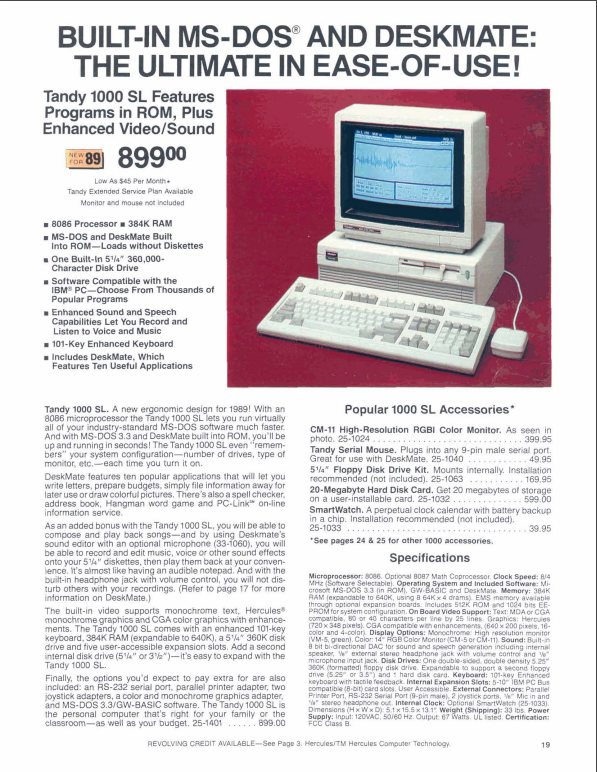
The Tandy 1000 SL
Along with the Tandy 1989 Computer Catalog came the Tandy 1000 SL. While there was no mystery or art to building a PC based computer, while perusing computer magazines of the day, it rapidly became obvious not all MS-DOS machines were created equal. Tandy was well aware of this issue, and decided to raise the bar with the 1000 SL; a computer loaded with features and priced for home use. Built around the Intel 8086 CPU, which ran at a software selectable 4 or 8MHz, one 5.25" 360k floppy drive and room for a second or a hard drive, and five 8 bit ISA XT style expansion slots, one RS-232 port, one parallel port, 384k RAM (expandable to 640k), and a 512k ROM (containing MS-DOS) and 1Kb EEPROM (which boots you to DeskMate at power on). Boot time to DeskMate was roughly ten seconds. A quick change to the EEPROM would have you boot to an MS-DOS prompt virtually instantly.
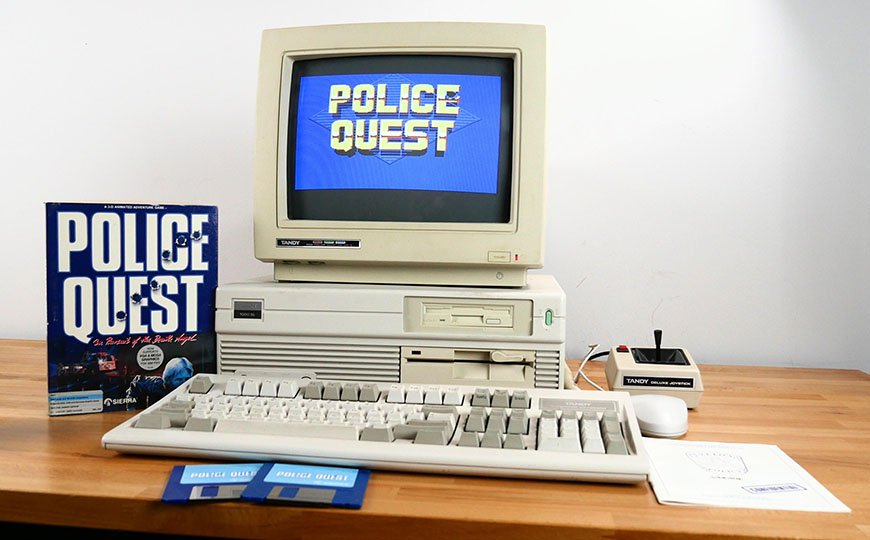
Other features making the Tandy 1000 SL quite appealing:
- Built in Enhanced CGA (Tandy Graphics) 16 color Hi-Res
- Two joystick ports
- Three voice integrated sound
- Analog/digital and back conversion
- Built in speaker
- Built in mic/phone jacks
- 101 key enhanced keyboard
- Integrated music editing software
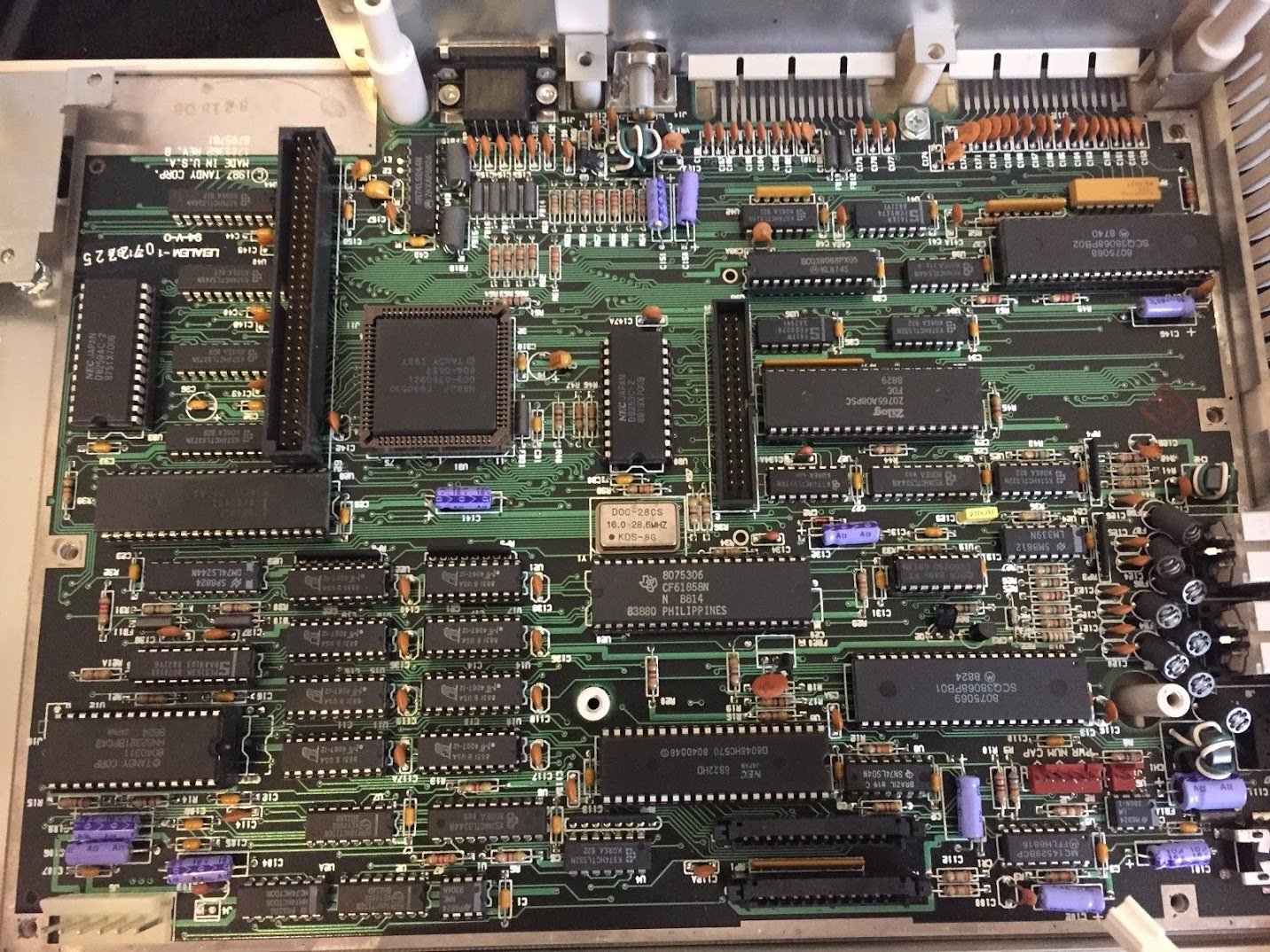
The 1000 SL came with a single 5.25" 360K floppy drive and 384 KB of memory. This was the last Tandy computer with two 5-1/4" drive bays. Although you can install 640 KB of memory, 32 KB is dedicated to graphics meaning a maximum of 576 KB can be used for software, preventing software that requires 640 KB from running.
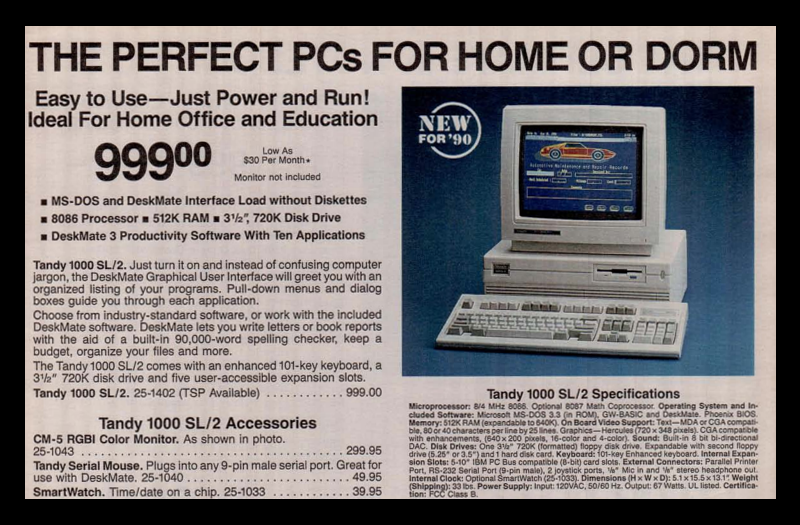
Tandy 1000 SL/2
The Tandy 1000 SL/2 was essentially a 1000 SL with a 3.5" floppy drive instead of 5-1/4" and 512 MB of memory from the factory instead of 384 MB.
Tandy 1000 TL Series
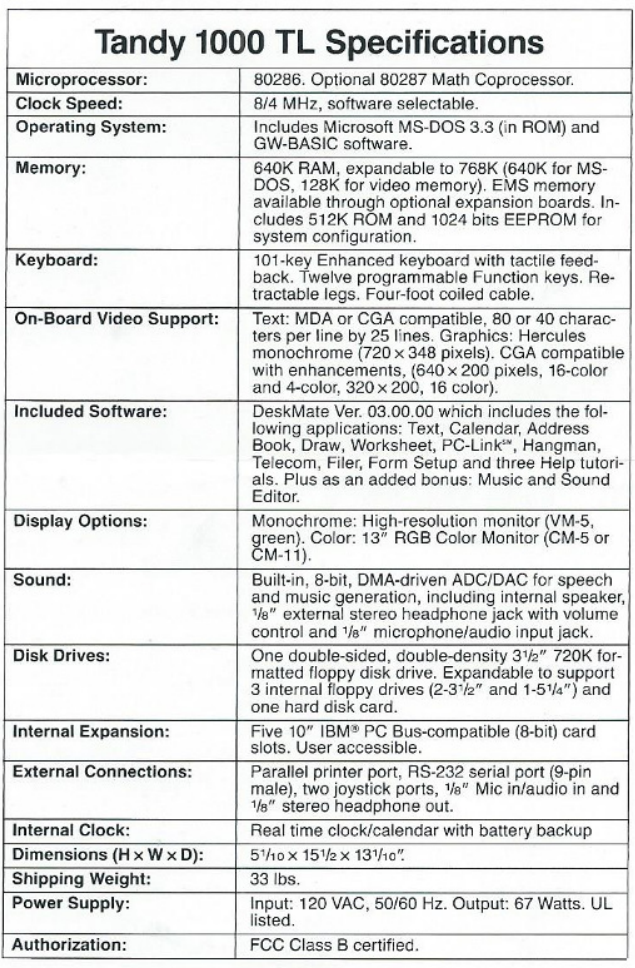
Also new for the 1989 Catalog year, was the Tandy 1000 TL. With an introductory price of $1299, the TL offered numerous features for the price right out of the box. While still an XT class computer, the TL came with the Intel 80286 CPU, real time clock and more:
- Intel 80286 @ 8MHz
- 640k RAM factory, upgradable to 720k
- Enhanced 101 key keyboard
- MS-DOS 3.30 & DeskMate in BIOS
- 3.5" 720k Floppy Drive
- Software compatible with IBM PC
- Enhance Sound/Speech
- DeskMate includes ten applications
- Real Time Clock/Battery
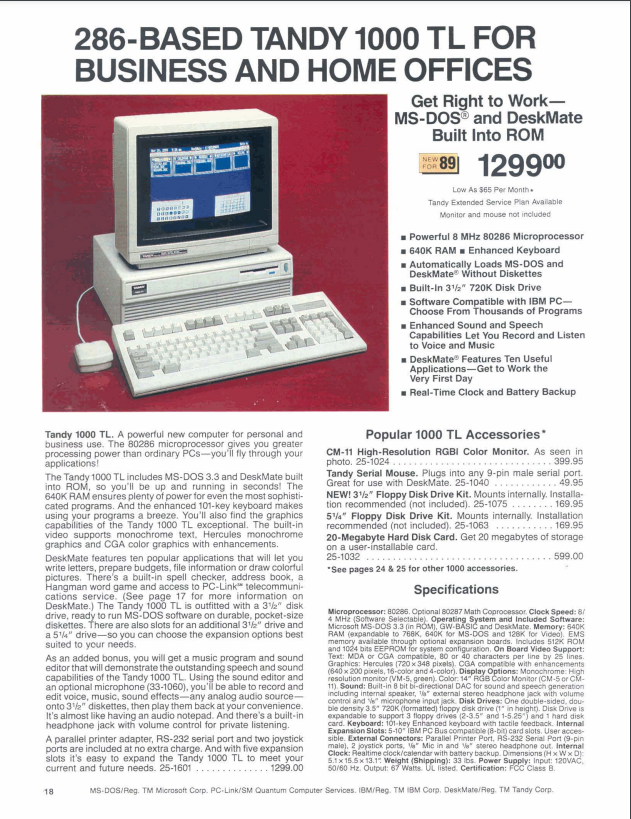
The Tandy 1000 TL offered five 8-bit XT compatible ISA slots - again, even though the TL had an 80286 CPU, this computer was still an XT class machine. In fact, I've seen it described as a Tandy 1000 TX (another XT class 1000) with improved graphics. Like the TX, the TL also had an Intel 80286, co-processor socket, 5 ISA slots, 640k, etc. Due to the CPU, the TL typically runs applications and games faster than a TX, however, not as fast as the AT class computer found with the same CPU.
Tandy 1000 SL vs. TL: A Detailed Breakdown
Released together for Tandy's 1989 computer catalog lineup, the Tandy 1000 SL and Tandy 1000 TL represented a major evolutionary step for the company's home computer ecosystem. While they shared a similar desktop chassis philosophy and targeted family/home-office environments, they sat at different price points and catered to users looking for distinct performance tiers.
1. Processing Core and Architecture
- Tandy 1000 SL: Powered by an Intel 8086 CPU, operating at a software-selectable speed of either 4 MHz or 8 MHz. While faster than the original 4.77 MHz IBM PC, it was fundamentally a traditional 16/8-bit hybrid processor performing at lower-end XT speeds.
- Tandy 1000 TL: Stepped up performance considerably by featuring an Intel 80286 CPU clocked at 8 MHz. Although it utilized an 8-bit ISA bus architecture rather than a full 16-bit AT bus, the 286 processor gave it a distinct speed advantage over the SL in CPU-bound applications.
2. Memory (RAM) Capacities
- Tandy 1000 SL: Shipped with 384 KB of RAM standard, expandable up to 640 KB. However, because 32 KB of this memory was permanently dedicated to the onboard video controller, users maxed out usable system RAM for software at 576 KB, occasionally causing compatibility snags with strict 640 KB requirements.
- Tandy 1000 TL: Shipped with a full 640 KB of RAM standard right out of the box, with capability to expand up to 720 KB, completely eliminating standard memory bottlenecks.
3. Operating System and Firmware Integration
- Tandy 1000 SL: Integrated a 512 KB ROM containing MS-DOS and a 1 KB EEPROM that allowed the machine to boot directly into DeskMate in roughly 10 seconds. Users could alter the EEPROM configuration to drop straight to an MS-DOS prompt if preferred.
- Tandy 1000 TL: Upgraded the onboard software suite by featuring MS-DOS 3.30 alongside DeskMate built directly into the BIOS ROM. Because DeskMate included roughly ten built-in applications, the TL provided a robust, turnkey productivity suite instantly at power-on.
Summary Comparison Table
| Feature | Tandy 1000 SL | Tandy 1000 TL |
|---|---|---|
| CPU | Intel 8086 (4 / 8 MHz) | Intel 80286 (8 MHz) |
| Standard RAM | 384 KB (576 KB usable max) | 640 KB (Expandable to 720 KB) |
| Operating System | MS-DOS / DeskMate in ROM | MS-DOS 3.30 / DeskMate in BIOS |
| Floppy Drive (Base) | 5.25" 360 KB | 3.5" 720 KB |
| Real-Time Clock | No | Yes (with battery backup) |
| Expansion Slots | Five 8-bit ISA | Five 8-bit ISA |
Market Reception and Consumer Impact
Market reception for the Tandy 1000 SL and Tandy 1000 TL (launched in 1989) was overwhelmingly positive, cementing Radio Shack stores as a premier destination for affordable home computing.
- The SL as a Retail Phenomenon: Priced competitively (often around $900 bundled with a monitor and software), the SL struck a chord with families and small business owners who wanted out-of-the-box MS-DOS compatibility without paying enterprise prices. Its instant-boot capability into DeskMate via ROM was praised heavily by mainstream computing press and everyday users alike as a massive leap in user-friendliness. By 1989, variations like the SL series had become the anchor of Radio Shack's computer sales, prominently displayed at the front of stores.
- The TL as a Power-User Favorite: Reviewers welcomed the TL as a smart bridge for consumers who wanted the raw speed of an 80286 processor without moving up to expensive, wide-footprint AT clones. While purists noted that its 8-bit bus architecture limited its true "AT-class" potential, home office users and enthusiasts appreciated its standard 640 KB RAM configuration, real-time clock, and expanded multimedia capabilities.
- Multimedia and Gaming Appeal: Both models received high marks from the gaming and hobbyist community. The inclusion of enhanced CGA graphics alongside upgraded 3-voice sound chips plus an 8-bit mono DAC/ADC for sample playback made them darling platforms for titles that specifically utilized Tandy audio routines.