
We're so RETRO it hurts the eyes
The Tandy 5000 MC
"Ultra Performance DOS System"
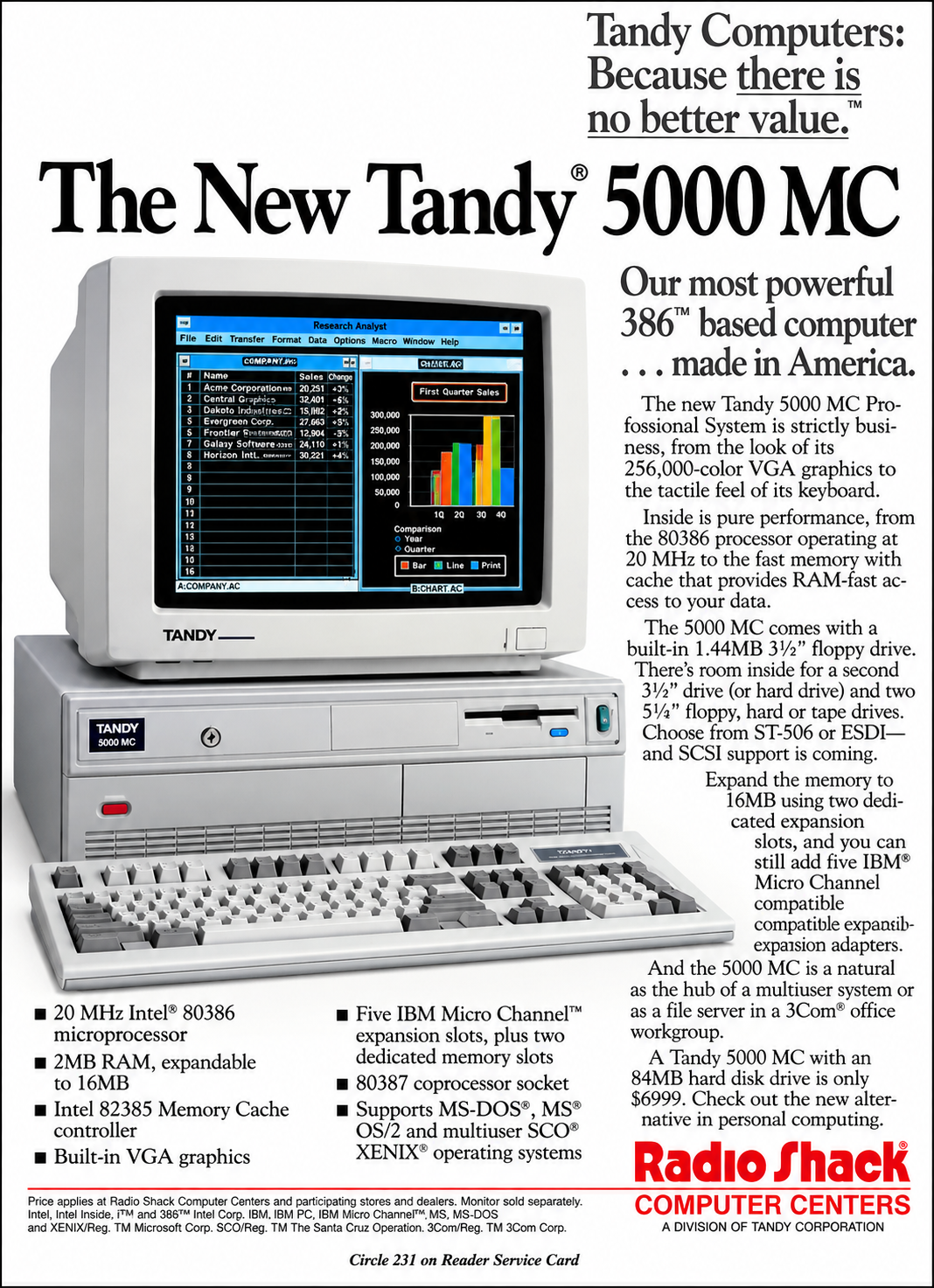
Tandy 5000
Released by Tandy Corporation in July 1988, the Tandy 5000 MC (Micro Channel) stood as one of the most technologically ambitious and powerful desktop machines ever produced under the Radio Shack banner. Designed to compete directly at the highest tiers of corporate enterprise computing, the 5000 MC marked a radical departure from traditional open architectures by embracing IBM's proprietary high-end system standard.
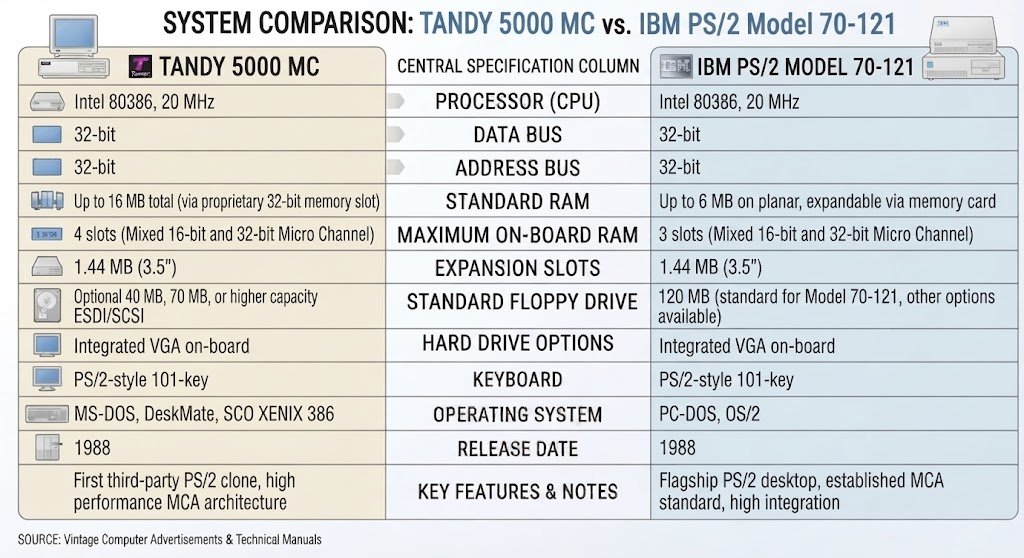
History and Industry Context
By the late 1980s, the personal computer market was flooded with standard ISA clone systems, prompting IBM to reclaim architectural control by introducing its second-generation Personal System/2 (PS/2) line centered around the proprietary Micro Channel Architecture (MCA). While most clone manufacturers initially hesitated or bypassed MCA due to licensing restrictions and patent fees, Tandy boldly dived in. Utilizing a new five-chip implementation chipset developed by Intel (the 82310 family), Tandy raced neck-and-neck with Dell to market, ultimately shipping the world's first true third-party PS/2 clone in the summer of 1988. Positioned as an elite workstation or heavy network file server, it aimed to capture lucrative corporate accounts that demanded bleeding-edge 32-bit hardware performance.
General:
- First Released: 1988
- CPU: 32-bit Intel 80386
- Clock speed: 20 MHz
- Bus type: IBM PS/2 compatible Micro Channel Architecture (MCA)
- Data bus width: 32-bit
- Address bus width: 32-bit
- Operating Systems: MS-DOS, DeskMate, and SCO XENIX 386
Memory:
- Base System Board Memory: Shipped with 2 MB standard RAM
- Maximum total memory: Up to 16 MB via 32-bit memory expansion slots
- Cache Controller: Intel 82385 cache controller with 32 KB high-speed static RAM cache
- Coprocessor Support: Socket for an optional Intel 80387 or Weitek 3167 math coprocessor
Communications/Ports:
- RS-232C serial communication ports
- Centronics parallel printer port
- PS/2-style mouse and keyboard connectors
- Micro Channel Architecture (MCA) 16-bit and 32-bit expansion slots with bus-mastering support
Video:
- Integrated Video Graphics Array (VGA) controller built directly onto the motherboard
- Supported 256 simultaneous colors (from a palette of 256,000) at 320x200 resolution
- Supported 16 colors at 640x480 resolution
- Compatible with high-resolution analog color and monochrome monitors
Storage:
- Floppy Drives: 3.5-inch high-density floppy disk drive (1.44 MB standard format)
- Hard Disk: Internal hard drive options including 40 MB MFM models up to high-capacity ESDI or SCSI configurations (reaching 170 MB+)
- Mass Storage Expansion: Four front-access drive bays supporting floppy, hard disk, and tape backup units
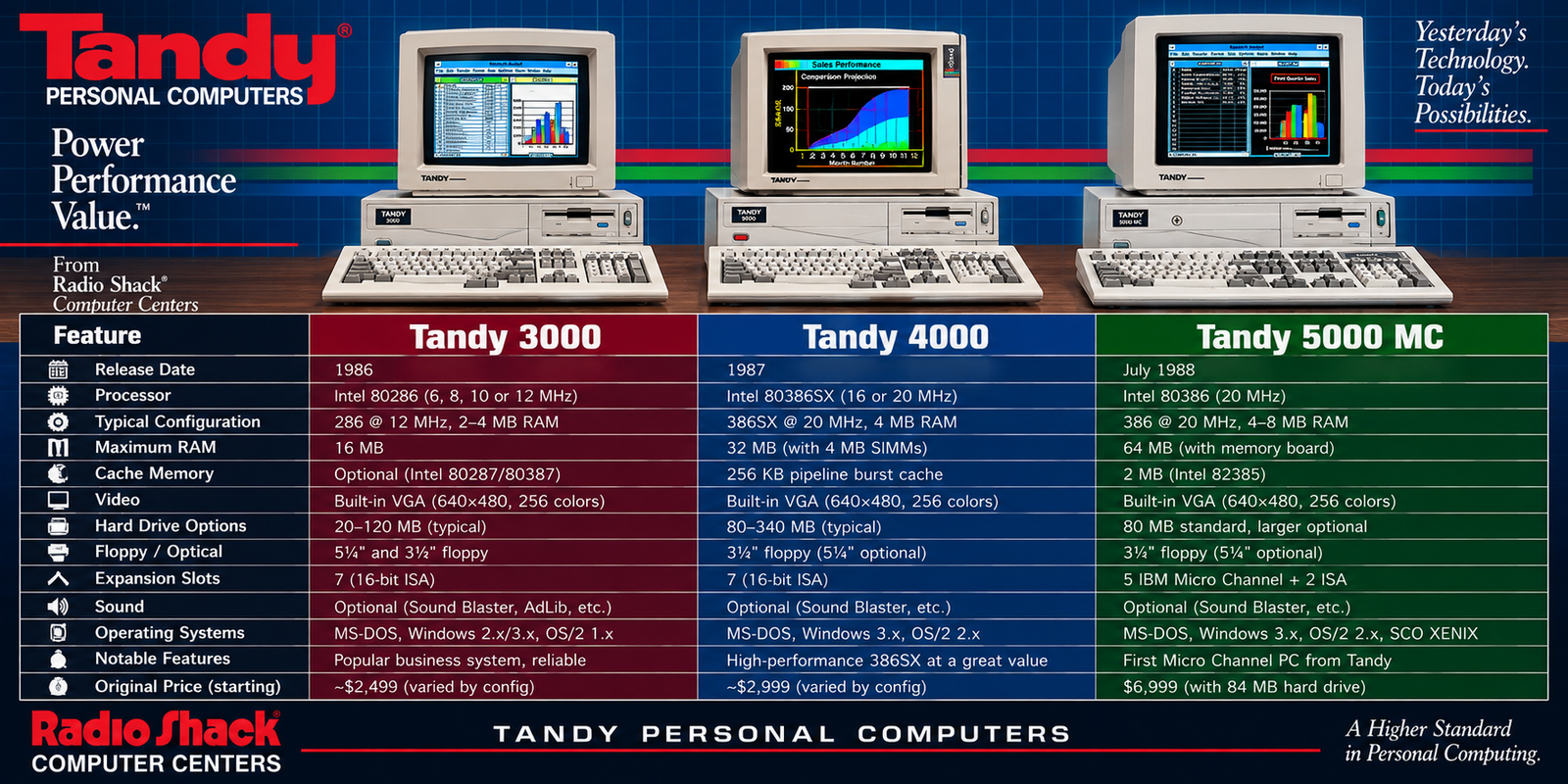
Hardware Features and IBM PS/2 Compatibility
At its core, the Tandy 5000 MC was built around a high-performance 20 MHz Intel 80386 microprocessor residing on a dedicated processor daughterboard. To ensure zero-wait-state processing performance, the system integrated an Intel 82385 Memory Cache Controller paired with 32 KB of high-speed static RAM cache.
Unlike Tandy’s earlier modular desktop models (such as the 3000 and 4000) which relied on traditional ISA slots and optional display cards, the 5000 MC heavily emulated IBM's highly integrated PS/2 layout. It featured built-in Video Graphics Array (VGA) support directly on the motherboard alongside integrated serial, parallel, and PS/2 mouse ports. Its expansion slots adhered strictly to IBM's Micro Channel standard, offering a mix of 16-bit and 32-bit MCA slots that supported bus-mastering and automated software-based configuration (replacing traditional jumpers and DIP switches for card setup).
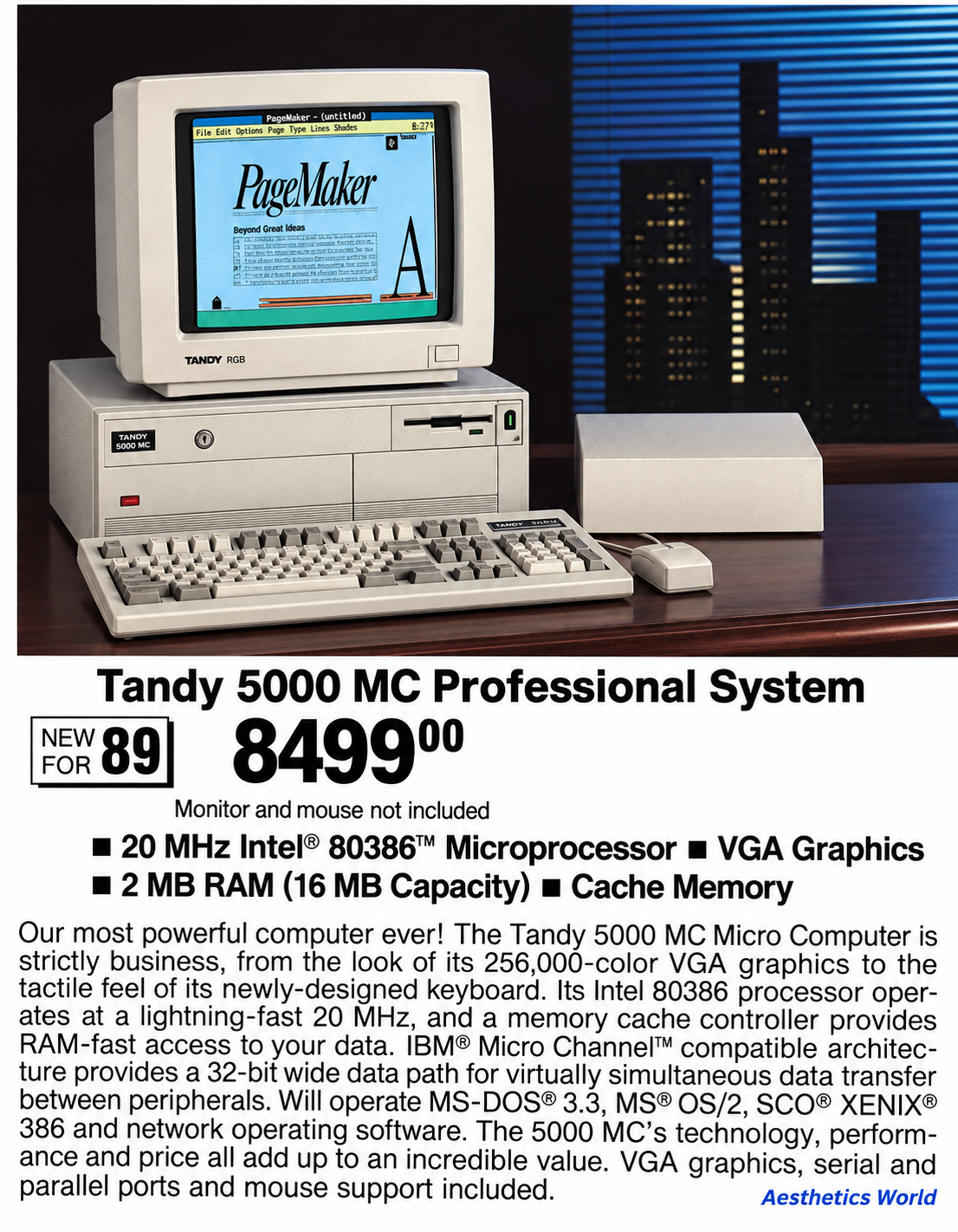
Performance Characteristics vs. IBM and Clones
When benchmarked by contemporary tech publications like PC Magazine, PC Week, and InfoWorld, the Tandy 5000 MC consistently punched above its weight class:
- Processing Speed: Its 20 MHz 80386 engine and dedicated 82385 cache controller allowed it to edge out IBM's first-party PS/2 Model 70-121 and match high-end enterprise rivals like the Compaq Deskpro 386/20e.
- Throughput: Reviewers praised the 32-bit data paths enabled by the Micro Channel bus, noting that it excelled under heavy multitasking workflows, large database queries, and multi-user environments running SCO XENIX 386.
- Value Proposition: While high-end machines of this caliber commanded steep investments, publications frequently highlighted that the Tandy 5000 MC offered superior expansion flexibility and raw performance benchmarks compared to IBM's equivalent models at a slightly lower price point.
The Micro Channel Gamble: Triumph of Engineering, Trap of Architecture
While technical reviewers praised the 5000 MC for outperforming IBM's own hardware at a competitive price, choosing Micro Channel architecture proved to be a double-edged sword. On one hand, MCA offered a true 32-bit data path and bus-mastering capabilities that optimized system throughput. On the other hand, it isolated the machine from the broader PC ecosystem.
- Zero ISA Compatibility: Because it embraced MCA, it completely abandoned the standard Industry Standard Architecture (ISA) bus. Corporate buyers could salvage none of their old modems or network cards and had to buy brand-new, expensive MCA expansion adapters.
- The Finicky Setup Trap: While MCA promised automated software-based configuration via Adapter Description Files (ADFs), troubleshooting a failed configuration on an unbootable MCA machine was often more frustrating than setting up traditional DIP switches.
- Storage Bottlenecks: Contemporary reviews noted that while the CPU and cache flew, entry-level models bundled with older ST-506 MFM hard drive controllers suffered from significantly slower read/write throughput compared to IBM's native high-end drives.
Model Variations and Configurations
Rather than a single static machine, the Tandy 5000 MC platform was sold in several tiered configurations depending on storage needs:
- Base System: Shipped with 2 MB of RAM, a 1.44 MB 3.5-inch high-density floppy drive, and integrated VGA graphics, initially retailing around $8,499.
- Hard Disk Upgrades: Factory bundles scaled up depending on the controller interface chosen. Lower-tier configurations utilized ST-506 MFM controllers paired with 40 MB hard drives, while high-end options incorporated faster ESDI controllers or high-capacity SCSI hard disk options reaching up to 170 MB.
Memory, Video, and Storage Upgrades
- Memory Architecture: The system came with 2 MB of standard RAM, mounted via SIMMs on dedicated, high-speed 32-bit memory slots located on the CPU daughterboard. Through these proprietary expansion slots, system memory could be scaled all the way up to 16 MB. A socket was also provided for an optional Weitek 3167 math coprocessor to accelerate floating-point calculations.
- Video Subsystem: The onboard VGA controller supported standard modes alongside 256 simultaneous colors (from a palette of over 256,000) at 320x200 resolution, and 16 colors at 640x480 resolution, driving Tandy's lineup of high-resolution analog color and monochrome monitors.
- Storage Flexibility: The chassis featured four front-access drive bays, accommodating a combination of 3.5-inch and 5.25-inch floppy drives, internal hard disks, or tape backup units.
Market Reception and Legacy
Despite receiving glowing reviews from technical journalists who lauded its superior engineering, speed, and hardware execution, the Tandy 5000 MC faced an uphill commercial battle. By 1988 and 1989, the broader personal computer industry was beginning to turn away from IBM's restrictive, proprietary Micro Channel architecture, rallying instead behind open standards like the Extended Industry Standard Architecture (EISA). Coupled with Radio Shack's historic difficulty in breaking past its consumer-retail identity into elite Fortune 500 corporate boardrooms, sales for the 5000 MC remained modest. Nevertheless, it remains a fascinating high-water mark for Tandy—proving that Radio Shack could engineer an enterprise-grade, state-of-the-art workstation that stood shoulder-to-shoulder with the giants of the industry.
This video provides a first-hand look at a related model in the lineup, showcasing the physical desktop hardware and design characteristics of Tandy's 1980s business computer systems.