
We're so RETRO it hurts the eyes
The Tandy 4000
"Ultra Performance DOS System"
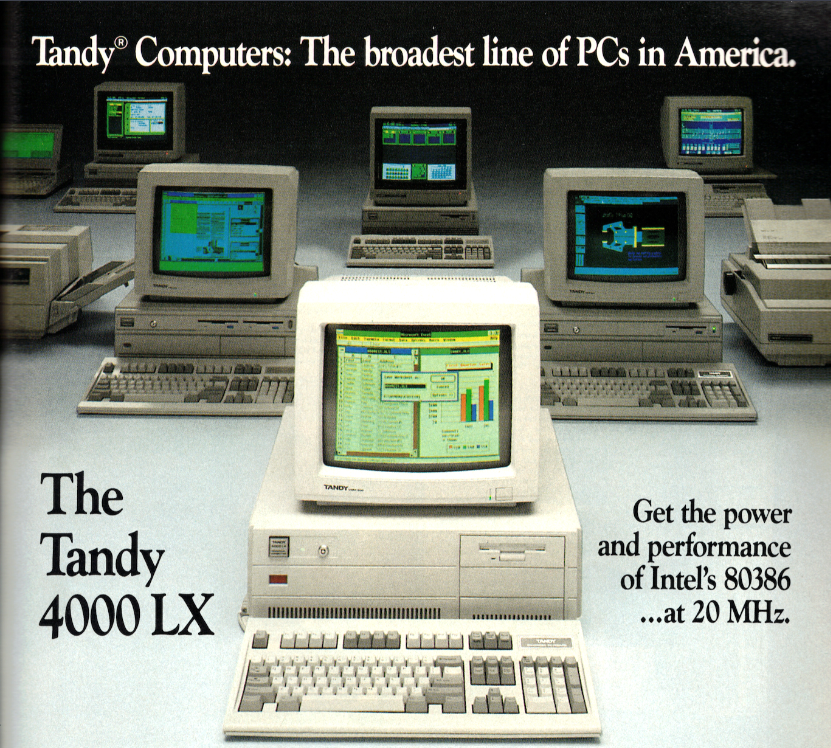
Tandy 4000
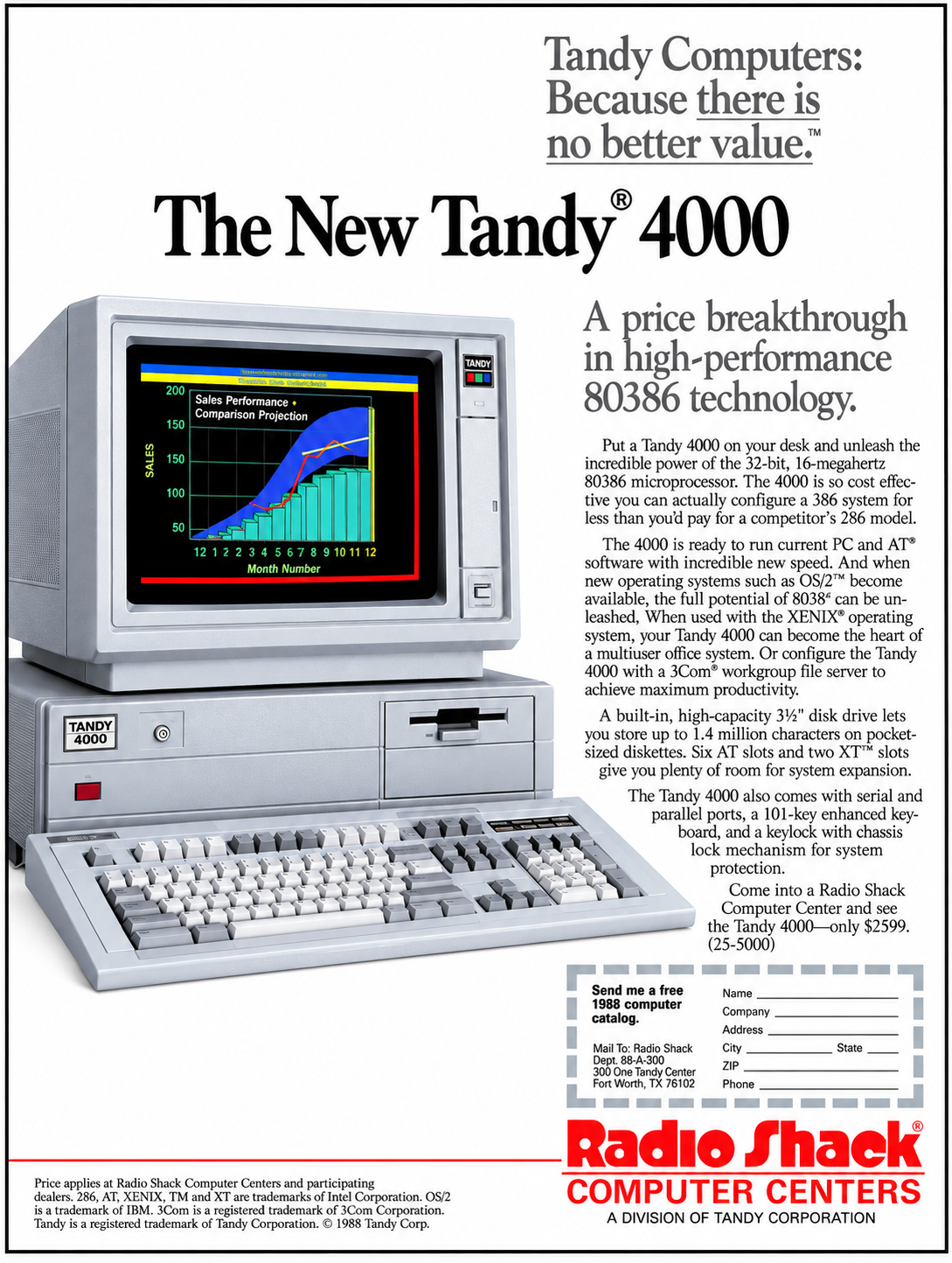
Released by Radio Shack in 1987, the Tandy 4000 represented a major technological leap forward for the company, establishing a strong foothold in high-performance desktop computing. Coming onto the market as the era of 32-bit computing began to dawn, the Tandy 4000 was engineered to provide minicomputer-level power inside a sleek, professional desktop package aimed at corporate power users, engineering firms, and demanding multi-user environments.
Hardware Features and IBM PC/AT Compatibility
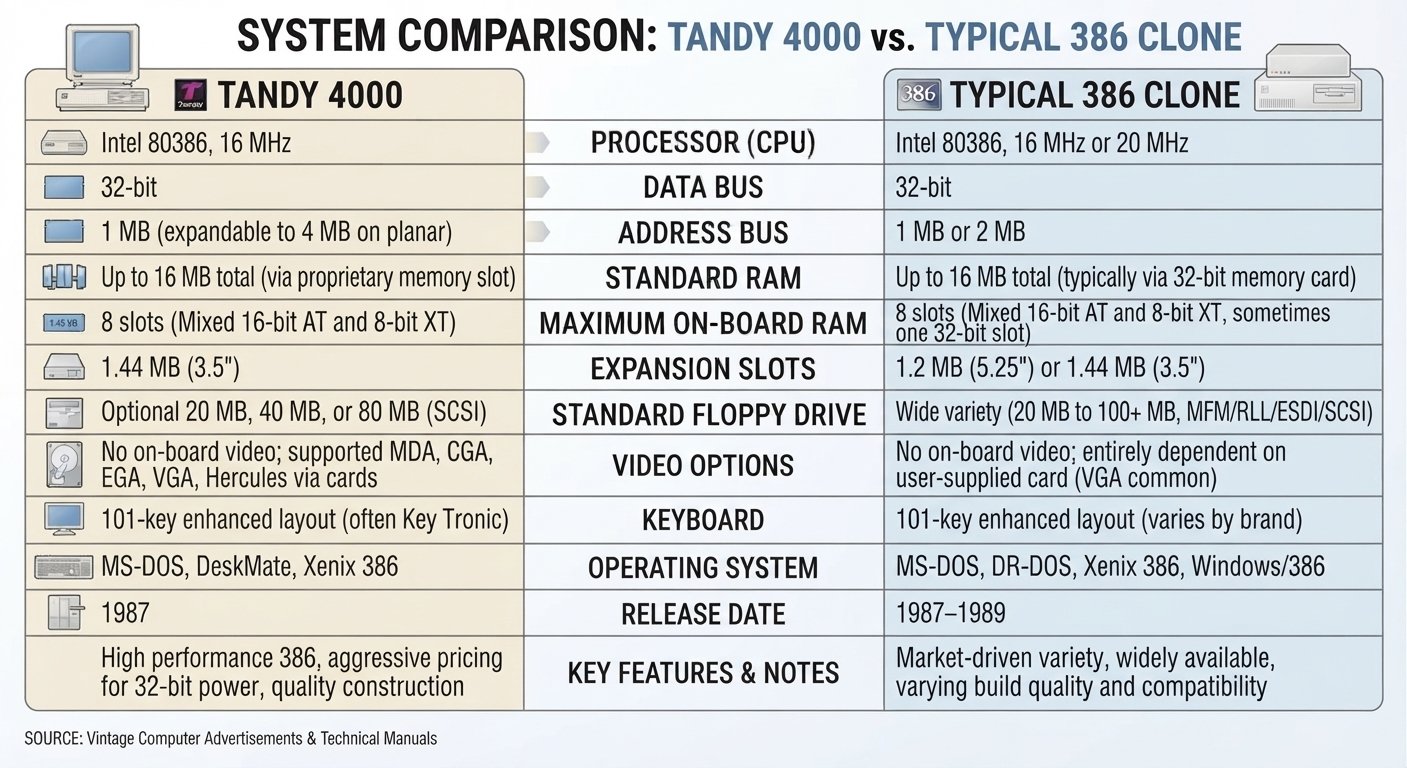
At the heart of the Tandy 4000 was Intel's powerful 32-bit 80386 microprocessor, running at a blazing 16 MHz clock speed. Despite its advanced 32-bit architecture, it was designed with robust backwards compatibility in mind. It featured a mixed expansion architecture containing both 16-bit AT-style slots and 8-bit XT-style slots, allowing it to accept a wide variety of standard ISA expansion cards. The system supported multiple operating modes (including real mode, virtual 8086 mode, and protected mode), ensuring full execution compatibility with existing 16-bit MS-DOS software, IBM PC/AT applications, and advanced multitasking environments.
General:
- First Released: 1987
- CPU: 32-bit Intel 80386
- Clock speed: 16 MHz
- Bus type: IBM PC/AT compatible mixed 16-bit and 8-bit ISA bus
- Data bus width: 32-bit
- Address bus width: 32-bit
- Operating Systems: MS-DOS, DeskMate, and Xenix
Memory:
- Base System Board Memory: Shipped with 1 MB standard RAM
- Maximum total memory: Up to 16 MB via memory expansion boards
- ROM: Phoenix BIOS standard
- Coprocessor Support: Socket for an optional Intel 80287 or 80387 math coprocessor
Communications/Ports:
- RS-232C serial communication port
- Centronics parallel printer port
- IBM PC/AT-style keyboard connector
- 16-bit and 8-bit ISA expansion slots for networking and peripheral add-ons
Video:
- No onboard video controller on the motherboard
- Video capability relied entirely on discrete expansion cards
- Supported standard IBM display adapters including MDA, CGA, EGA, VGA, and Hercules graphics
Storage:
- Floppy Drives: 3.5-inch high-density floppy disk drive (1.44 MB standard format)
- Hard Disk: Internal hard drive options including 20 MB, 40 MB, and higher capacity SCSI or ST-506 configurations
- Mass Storage Expansion: Fully compatible with standard AT hard disk and controller upgrades
Memory, Video, and Storage Options
- Memory: The system shipped with 1 MB of RAM standard on the motherboard, which could be expanded up to 4 MB directly using onboard memory and a dedicated memory slot. Utilizing high-density chips, total system memory could scale up to a massive 16 MB. An optional socket was also provided for an Intel 80287 (or compatible) math coprocessor to accelerate floating-point math.
- Video: Like its predecessor the Tandy 3000, the 4000 omitted onboard video controllers to give users maximum flexibility, relying instead on expansion slots to host MDA, CGA, EGA, or VGA graphics cards depending on business requirements.
- Storage: The base unit featured a modern 3.5-inch 1.44 MB floppy disk drive, with internal chassis bays capable of accommodating extra floppy drives, tape backups, or high-capacity hard disk drives.
The Tandy 4000 Model Lineup
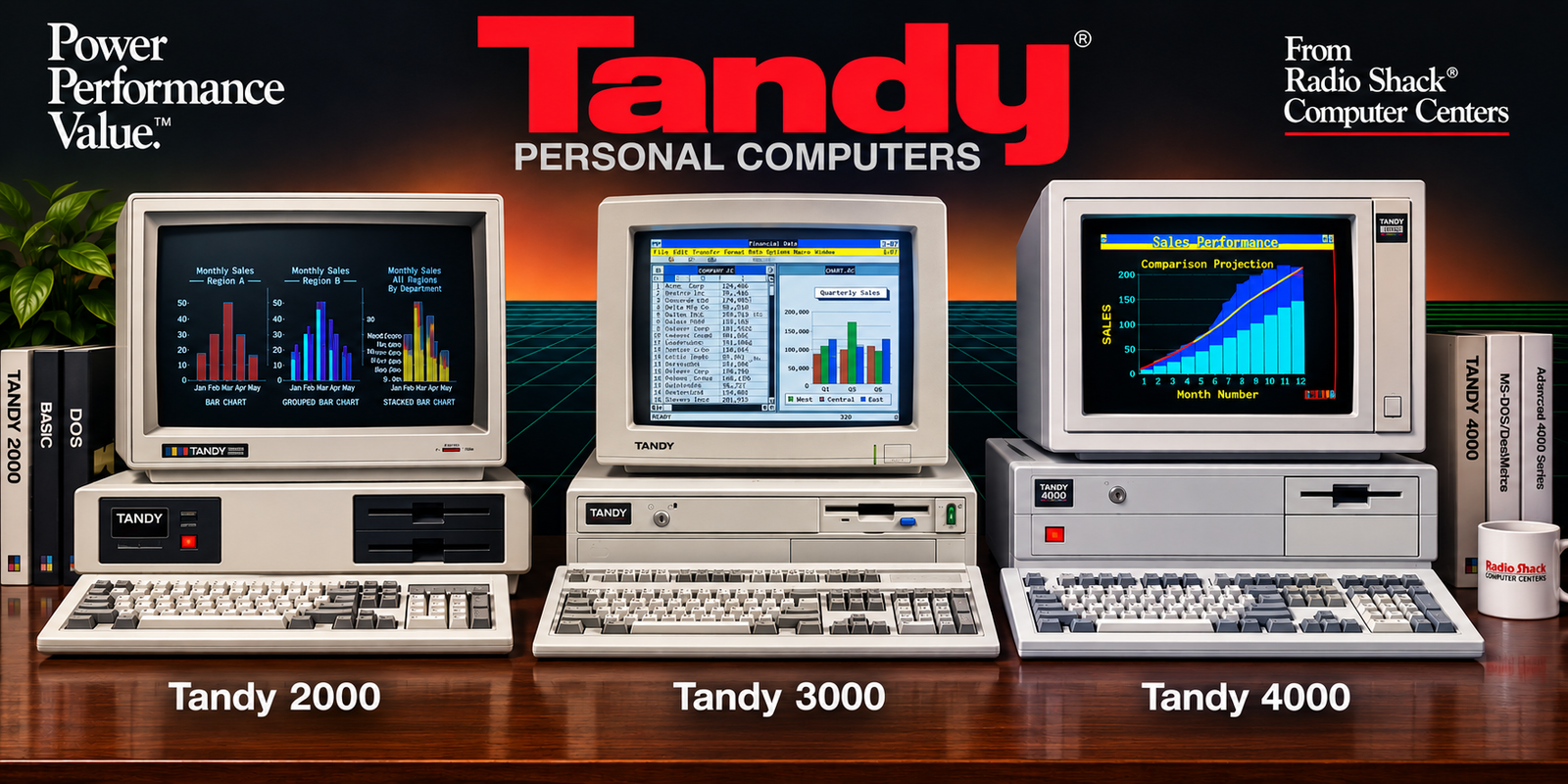
To address different workplace budgets and storage requirements, Tandy offered several iterations within the 4000 family:
- Tandy 4000 (Base Model): The initial 1987 flagship featuring the 16 MHz 80386 CPU, 1 MB of standard RAM, and a high-density 3.5-inch 1.44 MB floppy drive, typically retailing around $3,799.
- Tandy 4000 HD: Configured specifically for businesses requiring localized mass storage, this variant bundled a high-capacity internal hard drive (such as 20 MB, 40 MB, or later 80 MB SCSI options) right out of the box, making it immediately ready for heavy database and XENIX multi-user setups.
- Tandy 4000 LX and SX Variants: Introduced in subsequent years (1988 and later), these follow-up models refined the motherboard layout, introduced sleeker chassis designs, and provided more cost-effective entry points—such as the SX line utilizing the lower-cost Intel 386SX chip—to broaden appeal as 386 systems became mainstream industry standards.
Market Reception
The market reception of the Tandy 4000 was generally favorable among tech journalists and power users who praised its impressive 32-bit processing speeds, build quality, and aggressive pricing relative to IBM's first-party offerings. Reviewers highlighted that getting an Intel 386 architecture at a competitive price point made high-end CAD, database management, and multi-user XENIX tasks much more accessible.
Despite this positive technical praise, market acceptance in the broader corporate sector remained limited. Radio Shack’s pervasive retail image as a consumer electronics and hobbyist storefront made it difficult to break into Fortune 500 boardrooms, where institutional buyers strongly preferred entrenched enterprise vendors like IBM, Compaq, or emerging corporate clone brands. Consequently, while the Tandy 4000 carved out a loyal niche among small-to-medium businesses and dedicated Radio Shack loyalists, its overall market share on a national scale remained modest, reflecting the wider industry challenge Tandy faced as it tried to pivot from consumer retail dominance to high-end enterprise computing.
This video provides a first-hand look at a related model in the lineup, showcasing the physical desktop hardware and design characteristics of Tandy's 1980s business computer systems.
Competitive Positioning: ISA Architecture vs. Industry Giants
When the Tandy 4000 debuted in 1987, it entered a fiercely contested corporate market dominated by high-end offerings from IBM and Compaq. By strategically leveraging open standards and aggressive pricing, Tandy carved out a distinct value proposition for cost-conscious enterprise buyers:
- The Open ISA Bus vs. IBM's Proprietary Micro Channel (MCA): In 1987, IBM introduced its PS/2 line featuring a closed, proprietary expansion bus called Micro Channel Architecture (MCA), forcing users to abandon old hardware and buy expensive, IBM-approved cards. By sticking with an open, mixed 16-bit and 8-bit ISA architecture, the Tandy 4000 allowed IT managers to salvage their existing hardware investments and choose from affordable third-party expansion cards.
- Undercutting the Market Leaders: While Compaq had beaten the industry to the punch with its late-1986 Deskpro 386, it commanded a heavy luxury price tag. The Tandy 4000 was engineered to deliver equivalent 16 MHz Intel 386 performance while undercutting both IBM and Compaq on price, making desktop 32-bit computing far more accessible to mid-sized businesses.
- The Multi-User XENIX Powerhouse: Beyond running standard MS-DOS applications, the Tandy 4000 was heavily marketed as a cost-effective alternative to expensive minicomputers (such as those from DEC) by running Microsoft XENIX. Businesses could connect multiple low-cost serial terminals to a single Tandy 4000, powering office-wide accounting and multi-user databases off one machine at a fraction of traditional mainframe costs.