
We're so RETRO it hurts the eyes
The Tandy 2000
"Ultra Performance DOS System"
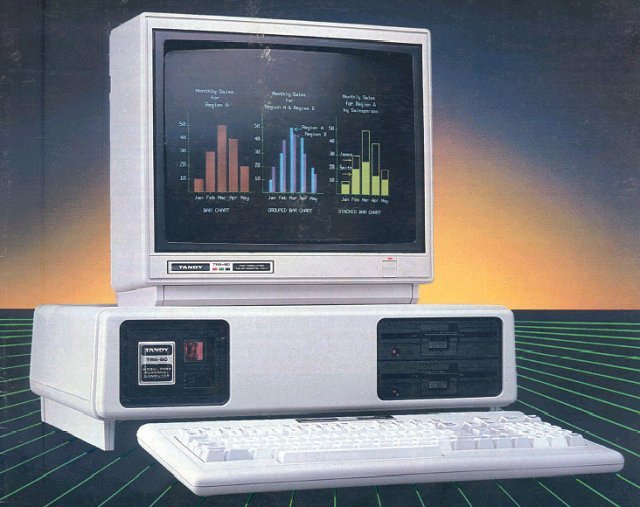
First appearing in the 1984 TRS-80 Computer Catalog (RSC-11), the Tandy TRS-80 Model 2000 was Tandy/Radio Shack's first PC compatible. However, the computer was actually released in 1983, with an introductory price of $2,750 for a dual floppy drive model, and $4,250 for a 10MB hard drive model. The Model 2000 was set to the IBM compatible PC market by storm. Or was it? This new foray into the PC world by Tandy started off a little... weird. The 2000 offered a faster CPU, more disk storage, easier expansion (arguably), and better graphics. Add to that a large library of software already on the market, and Tandy thought they had a winner.
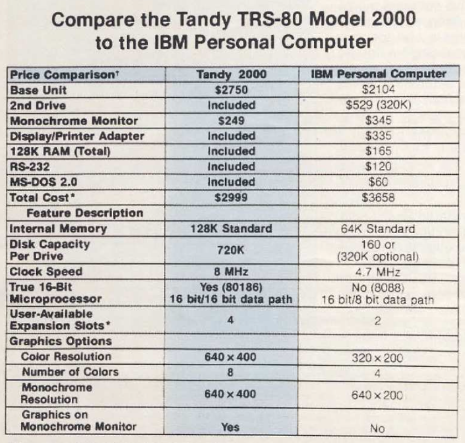
The basic system shipped in the following configuration: two 720k 5 1/4" floppy drives, display adapter, printer adapter, 128k RAM, RS-232 port, and MS-DOS 2.0. It could all be yours for $2,750. By comparison, an IBM PC, similarly equipped (though with smaller drives and less RAM) was $3,658. Tandy opted to go with the not quite mainstream Intel 80186 CPU, running at 8MHz. The display capabilities were impressive, 640 x 400 in color or monochrome. Another option was to buy the machine with a single 720k floppy drive, and a 10MB hard drive, all for the bargain price of $4,250.
Tandy 2000 Ecosystem & Technical Deep-Dive
While the Tandy 2000 boasted superior paper specs over IBM's contemporaneous hardware, navigating its ecosystem required specific hardware configurations and tailored software ports. Below is an overview of its architectural constraints, software availability, and a quick reference specification table.
Proprietary Peripherals and Keyboard Design
Beyond its core architecture, the Tandy 2000's user experience was heavily defined by its physical peripherals. The system shipped with a sleek, low-profile detached keyboard that received widespread praise from contemporary reviewers for its superior typing feel compared to the stiff, loud keyboards bundled with early IBM hardware. However, this comfort came with a catch: the keyboard used a unique internal scan-code set and proprietary connector pinout, meaning users could not simply swap it out for standard third-party IBM PC replacement keyboards.
The Lesson Learned: Paving the Way for the Tandy 1000
Ultimately, the market struggles of the Tandy 2000 served as a crucial turning point for Radio Shack's engineering strategy. By discovering that corporate and home buyers would reject even a faster machine if it couldn't freely run standard off-the-shelf software, Tandy completely shifted gears. The hard lessons learned from the 2000's proprietary architecture directly birthed the wildly successful Tandy 1000 line later in 1984; a machine that combined true IBM software compatibility with upgraded custom audio and video features, capturing the market that the Model 2000 narrowly missed.
| Tandy 2000 Quick Technical Specifications | |
|---|---|
| CPU / Processor | Intel 80186 (True 16-bit data and address path) running at 8 MHz |
| Standard RAM | 128 KB (Expandable to 768 KB on-board) |
| Floppy Format | 5.25-inch high-capacity floppy drives (720 KB formatted storage per disk) |
| Graphics Resolution | 640 x 400 high-resolution graphics (both color and monochrome modes) |
| Operating System | Tandy-specific MS-DOS (culminating with version 2.11.03) |
Key Software Titles
Because standard PC-DOS software that bypassed the BIOS to talk directly to hardware registers would crash the system, users relied on specific software titles explicitly compiled and ported for the Tandy 2000 architecture. Major productivity releases included:
- Microsoft Multiplan: A primary spreadsheet option optimized to run under the 2000's environment.
- Lotus 1-2-3: Specially re-compiled versions that could address the machine's distinct video memory maps.
- MultiMate & Microsoft Chart: Handled heavy-duty word processing and graphical data presentation leveraging the machine's 640x400 capability.
- Tandy's Deskmate: The venerable Tandy multi-purpose app specially recompiled to run on the 2000 and its 80186 processor.
Math Coprocessor and Performance Constraints
For scientific, engineering, and heavy computational tasks, floating-point math support was a critical consideration. The architecture of the 80186 meant it lacked the straightforward external coprocessor socket pinouts found on standard 8088/8087 rigs, making high-speed floating-point upgrades complex and heavily reliant on specialized third-party board implementations rather than a drop-in 8087 chip.
Peripherals, Display, and Expansion
The system's advanced capabilities demanded specialized companion hardware:
- Specialized Monitors: To display the crisp 640 x 400 graphics modes, users could not rely on standard low-frequency IBM CGA or MDA screens; the Tandy 2000 required its own dedicated high-frequency monitor options.
- Proprietary Interfacing: The keyboard layout, along with the layout for serial and printer ports, utilized proprietary pinouts and controllers, necessitating custom adapter cables when connecting off-the-shelf peripherals.
Tandy was fairly proud of the Model 2000, and they had reason to be. After all, it was more powerful than any of the IBM hardware available when the 2000 launched, and it was better equipped for home and office use than the IBM PC. So what's the problem? It wasn't fully compatible with the PC software or hardware
on the market at the time. The 80186 CPU was a true 16 bit processor - address and data path. The 80186 had additional on-chip features that didn't exist on other 'x86 family members, which were mapped to differing I/O space, making a true compatible from an 80186 nearly impossible. Further, the printer and serial ports were proprietary, requiring adapters to interface with popular devices. As far as the BIOS was concerned, it was compatible with the PC/XT and behaved well with MS-DOS. However, the software available tended to work directly with the hardware, bypassing the BIOS and operating system in order to
achieve a high level of performance - this left the software incompatible with the Tandy 2000 hardware.
At the same time, the Tandy could implement more memory than the 640k on true PC hardware, and the 640 x 400 graphics (just shy of VGA) was incredible for the time. As far as DOS was concerned, the MS-DOS was a special version that would run only on the Tandy 2000. Standard versions of MS-DOS and PC-DOS would not run on the machine. This did not concern Microsoft as they expected different versions for differing architectures. Radio Shack's last release of DOS for the Tandy 2000 was 2.11.03.
The TRS-80 Model 2000 was the end of the line for the TRS-80 branded machines, coming just as the computer industry as a whole was embracing the MS-DOS standard brought in with the first IBM PC. The sales of the 2000 were not spectacular, fairing quite poorly in the market. What it did do was lay the foundation for the wildly successful Tandy 1000 line.