
We're so RETRO it hurts the eyes
The Tandy 3000
"Ultra Performance DOS System"
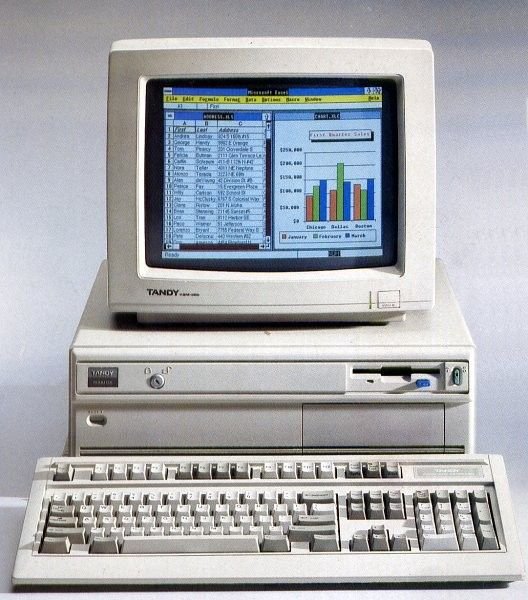
Tandy 3000
Released by Radio Shack in 1986, the Tandy 3000 entered the market during a pivotal shift in personal computing, serving as Tandy's high-performance response to the booming market for IBM-compatible desktop workstations. Moving away from Tandy's proprietary computing roots, the machine was designed to target corporate environments, power users, and advanced professionals who required serious desktop horsepower. It arrived as a direct spiritual successor to the earlier Tandy 2000 (which used an Intel 80186 processor and struggled with strict IBM compatibility) by fully embracing the industry standards established by IBM.
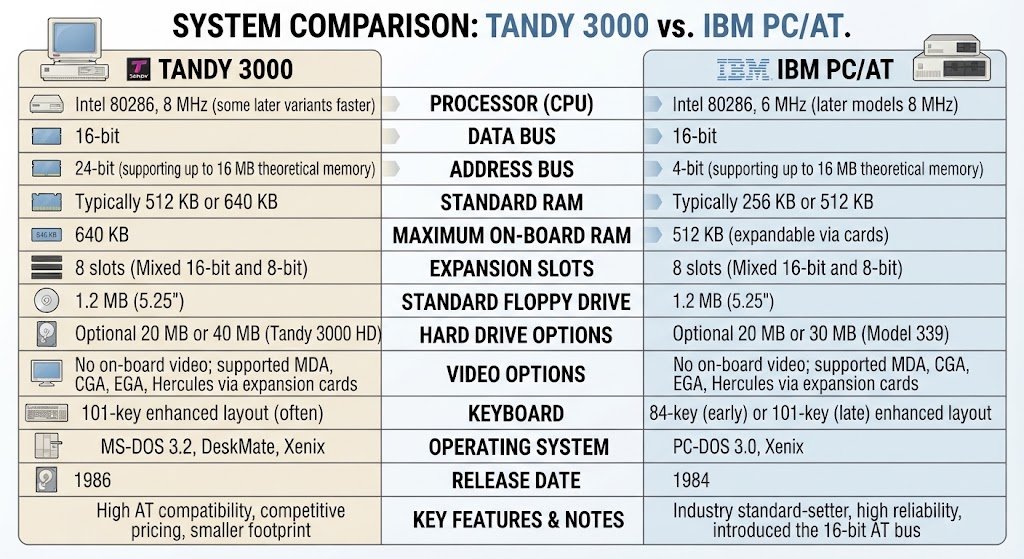
Hardware Features and IBM PC/AT Compatibility
At its core, the Tandy 3000 was built around the 16-bit Intel 80286 microprocessor, initially clocking at 8 MHz (with later variants and clones pushing performance further). Designed from the ground up for high hardware-level compatibility with the IBM PC/AT, it featured a physical layout and bus architecture modeled closely after IBM’s benchmark machine. It incorporated a 16-bit ISA expansion bus structure, allowing it to accept a wide variety of third-party expansion cards, modems, and network controllers designed for the AT standard. While it ran standard operating systems like MS-DOS (typically version 3.2), DeskMate, and multi-user environments like Xenix, its degree of BIOS and hardware register compatibility allowed it to run demanding productivity software, databases, and early computer-aided design packages smoothly.
General:
- First Released: 1986
- CPU: 16-bit Intel 80286
- Clock speed: 8 MHz (later variants featured higher speeds)
- Bus type: IBM PC/AT compatible 16-bit ISA bus
- Data bus width: 16-bit
- Address bus width: 24-bit
- Operating Systems: MS-DOS 3.2, DeskMate, and Xenix
Memory:
- Base System Board Memory: Shipped with 512 KB to 640 KB conventional RAM
- Maximum on-board DRAM: Up to 1 MB directly on the main board
- Maximum total memory: Up to 12 MB or higher via expansion cards
- ROM: Phoenix BIOS standard
- Coprocessor Support: Socket for an optional Intel 80287 math coprocessor
Communications/Ports:
- RS-232C serial communication port
- Centronics parallel printer port
- IBM PC/AT-style keyboard connector
- 16-bit and 8-bit ISA expansion slots for networking and peripheral add-ons
Video:
- No onboard video controller on the motherboard
- Video capability relied entirely on discrete expansion cards
- Supported standard IBM display adapters including MDA, CGA, EGA, and Hercules graphics
Storage:
- Floppy Drives: High-density 5.25-inch floppy disk drives (1.2 MB standard format)
- Hard Disk: Internal hard drive configurations ranging from 20 MB upwards using controller cards
- Mass Storage Expansion: Fully compatible with standard AT hard disk and controller upgrades
Video and Storage Options (Made in America)
Unlike Tandy's consumer-focused Tandy 1000 line—which famously integrated specialized graphics and sound hardware onto the motherboard—the Tandy 3000 left video processing entirely up to expansion slots. It did not feature onboard video; instead, users installed discrete expansion cards supporting Monochrome Display Adapter (MDA), Color Graphics Adapter (CGA), Enhanced Graphics Adapter (EGA), or Hercules graphics depending on workplace needs.
Storage capabilities were equally flexible. The machine supported high-density 5.25-inch floppy disk drives (typically managing 1.2 MB formats), alongside internal hard disk upgrades. Factory and aftermarket configurations frequently included internal hard drives ranging from 20 MB upward, connected via standard hard disk controller cards, giving professionals ample local storage for operating systems, application suites, and large corporate datasets.
Models and Differences
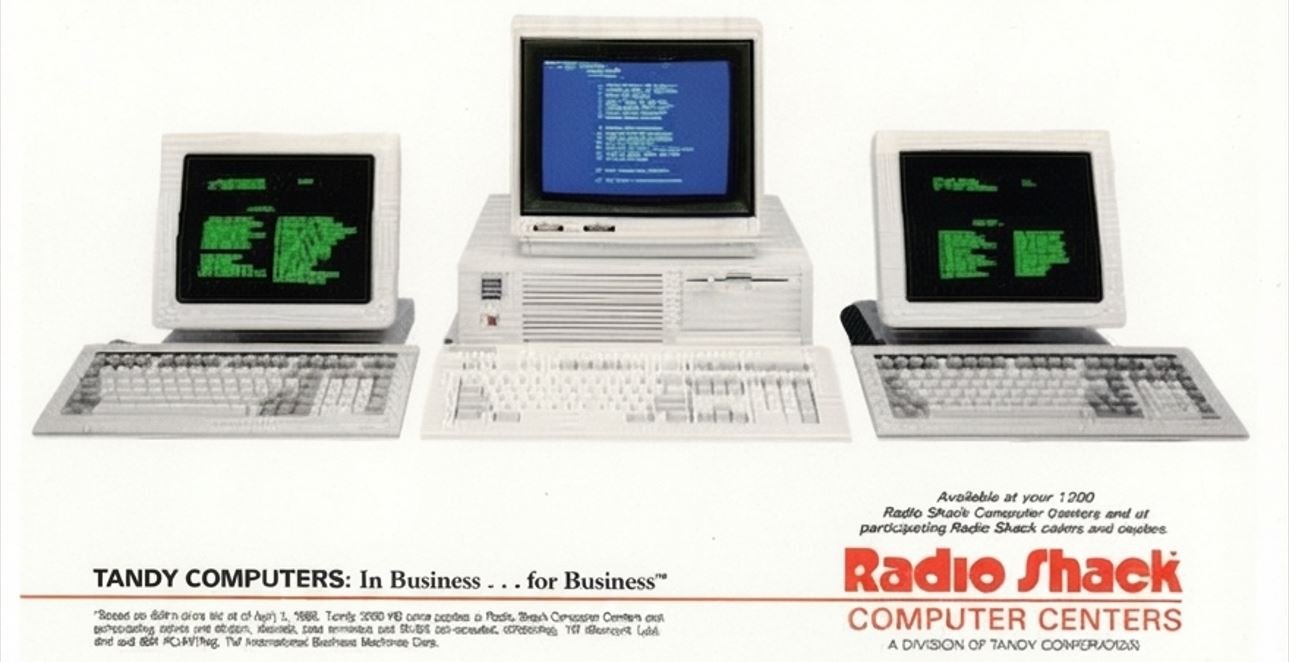
Building on the original heavy desktop design, Tandy expanded the 3000 lineup into several specialized variants to target different market segments:
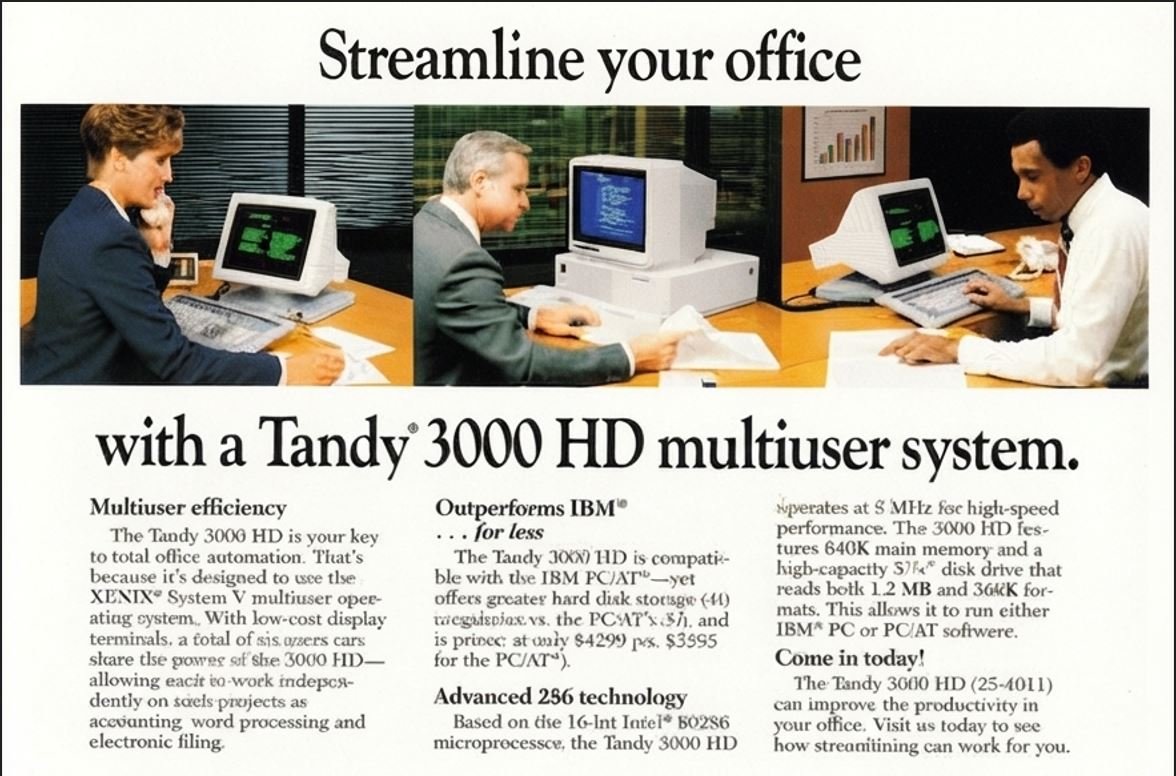
- Tandy 3000 HD: The premier high-end workstation configuration. It featured a standard 8 MHz Intel 80286 processor, 512 KB to 640 KB of base RAM, and an internal hard drive (commonly 20 MB or 40 MB). It was built explicitly for corporate environments and multi-user setups running SCO XENIX, leveraging its built-in battery-backed real-time clock and robust expansion capacity.
- Tandy 3000 HL (Half Line): Introduced as a smaller, lower-cost desktop alternative for single-user professional and small-office environments. The HL featured a more compact chassis ("half line" height), a reduced physical footprint, fewer expansion slots, and a scaled-down power supply, offering budget-conscious buyers entry into IBM PC/AT compatibility without paying for heavy-duty multi-user overhead.
- Tandy 3000 NL: Representing the later phase of the product line before it was superseded by 386-based systems, the NL model retained similar core performance specs but underwent a complete motherboard redesign. This internal layout revision streamlined manufacturing costs, improved component reliability, and modernized internal bus routing to better align with evolving industry standards.
Market Reception
Despite offering a compelling blend of IBM PC/AT hardware compatibility, high-performance multi-user capabilities via XENIX, and competitive pricing, the Tandy 3000 ultimately achieved only modest commercial success and occupied a relatively small fraction of the broader corporate market. Because Radio Shack's retail chain was deeply anchored in consumer electronics and hobbyist computing, business buyers often favored established corporate heavyweights like IBM, Compaq, or emerging clone manufacturers. Consequently, total production numbers were relatively low, making units scarce today. Nevertheless, the machine played an important transitional role in Tandy's history; by abandoning proprietary architectures in favor of open industry standards, it demonstrated that Radio Shack could successfully engineer advanced desktop workstations capable of running mainstream enterprise software, permanently shifting the company’s trajectory toward the IBM-compatible standard that came to dominate the computing landscape.
This video provides a first-hand look at a related model in the lineup, showcasing the physical desktop hardware and design characteristics of Tandy's 1980s business computer systems.