
We're so RETRO it hurts the eyes
The Tandy 1200 HD
"Radio Shack's True IBM PC/XT Heavy-Duty Workhorse"
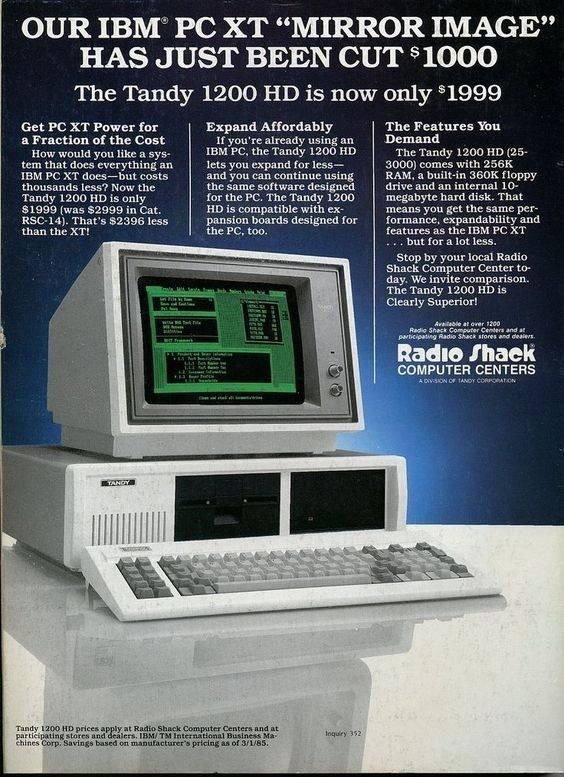
Overview
Released in late 1984, the **Tandy 1200 HD** marked a major strategic shift for Radio Shack. While the landmark consumer-focused Tandy 1000 relied on partial PCjr/IBM compatibility and built-in multimedia features, the 1200 HD was engineered as an uncompromising, pin-compatible clone of the industry-standard **IBM PC/XT (Model 5160)**. Built to capture professional offices and corporate desks, it bypassed proprietary designs to run off-the-shelf business software right out of the box.
Deep-Dive Hardware Analysis
Housed in a rugged, heavy steel desktop chassis mirroring IBM's industrial design language, the 1200 HD leveraged high-grade manufacturing largely contracted through **Tandon Corporation**—famous for supplying disk mechanisms to the original IBM PC. Rather than condensing everything onto a single proprietary motherboard like the later 1000 series, the 1200 HD followed a modular, card-based philosophy identical to IBM's architecture.
Core Technical Specifications:
- Processor: Intel 8088 CPU running at the standard IBM-compatible 4.77 MHz clock speed.
- Motherboard Memory: Shipped standard with 256 KB of RAM on-board, modularly expandable up to the MS-DOS conventional memory limit of 640 KB via expansion chips or cards.
- Storage Subsystem: Featured a factory-installed 10 MB MFM hard disk drive (Winchester-style mechanism) paired with a single 360 KB 5.25-inch double-sided, double-density floppy disk drive.
- Bus Architecture & Expansion: Equipped with five full-size 8-bit ISA expansion slots. Because it used standard ISA architecture, it accepted off-the-shelf expansion cards without modification.
- Video & Display Options: Unlike the Tandy 1000, video was handled modularly. Systems could be configured with either an STB-manufactured Monochrome Display Adapter (MDA) running text-based green/amber screens, or a Color Graphics Adapter (CGA) card driving compatible RGB monitors.
- Coprocessor Support: Included a dedicated socket on the motherboard for an optional Intel 8087 math coprocessor to accelerate heavy spreadsheet and floating-point computations.
Market Positioning and Competitor Analysis
In 1984 - 1985, the corporate desktop space was heavily contested. The Tandy 1200 HD went head-to-head against formidable rivals:
- The Benchmark - IBM PC/XT (Model 5160): IBM's official XT commanded a steep retail presence, often costing well over $4,000 to $5,000 once outfitted with a 10 MB hard drive and memory upgrades. Tandy positioned the 1200 HD to undercut IBM directly, launching at an aggressive base price of **$2,995** while offering identical software compatibility and equivalent hardware throughput.
- The Plug-Compatible Rival - Compaq Deskpro / Plus: Compaq had famously pioneered the portable and desktop clone market with high build quality. While Compaq machines often added minor performance enhancements (like dual-speed processors), Tandy leveraged its massive domestic retail footprint—allowing small-to-mid-sized business buyers to walk into a local Radio Shack for face-to-face enterprise support and service.
- Generic "White Box" XT Clones: Mail-order operations and local component shops sold cheaper clone motherboards, but they lacked warranty backing and reliable quality control. The Tandon-built engineering of the Tandy 1200 HD gave corporate buyers enterprise-grade reliability without sacrificing standard hardware compatibility.
Internal Lineup Distinction: Tandy 1200 HD vs. Tandy 1000
Radio Shack maintained a strict boundary within its catalog:
- Tandy 1000: Targeted homes and schools; featured integrated composite/RGB video, built-in 3-voice sound, and a cheaper plastic-accented enclosure.
- Tandy 1200 HD: Strictly targeted corporate offices, engineering benches, and accounting departments requiring heavy steel build quality, absolute IBM XT BIOS compatibility, and native hard-disk storage for database applications.
Legacy and Market Acceptance
The Tandy 1200 HD proved critical in establishing Radio Shack's credibility beyond hobbyist electronics and TRS-80 microcomputers. By offering true blue-collar IBM compatibility at a thousand-dollar discount over Big Blue, it captured significant regional business accounts. Though it eventually yielded the floor to faster 80286-based machines like the Tandy 3000, the 1200 HD remains celebrated as a bulletproof bridge into the golden age of MS-DOS enterprise computing.
Retrospective & Overview Videos
Explore first-hand hardware breakdowns and deep-dives into the architecture of the Tandy 1200 HD:
An IBM PC XT Clone from 1985: The Tandy 1200 HD Hardware Overview — Source: [YouTube]
The Tandy 1200 Commercial featuring Bill Bixby — Source: [YouTube]